Entering into the various layered networks of the PiShock user-dev community has provided numerous fascinating insights and clearly demonstrated the importance and accuracy of my dissertation argument. Many sexual experiences in our present historical moment are not only mediated by digital technology and networks, but the experience, the experiencing body, and the identity community (or public) centered on it are emergent from coconstruction with the technical objects themselves. What demonstrates this most plainly is that this ecosystem exists and functions at all: the diverse interactions happening between user-devs, regular users (both wearers and inputs), Discord, Reddit, StackOverflow, and the PiShock ownership/production/operation team — to say nothing of the supply chains and parcel services also integral to these systems, or even of the technical devices themselves and the computers, wires, networks, protocols, and programming languages, ad nauseam, that compose the system between its obvious human nodes.
Bodies, experiences, and identities are bound up in the digital processes of operating these devices, as well as an array of novel forms of rhetorical interaction. The PiShock’s development side is largely intended for public-facing projects and especially integration into streaming culture. Through the PiShock API and/or WebSocket, streamers are able to offer control of their device (sensation-defining inputs) to remote, digital audiences en masse. And through these bodily mediated interactions, sensation is produced at both ends of the channel: pleasure-pain in the documented body and control-pleasure in the observer body. This interactive, synchronous pornography redefines the relationship between digital performer and digital audience, further complicated by the inscription of these events as both stored-time video and as interaction logs preserving time, duration, intensity, and originating IP address.
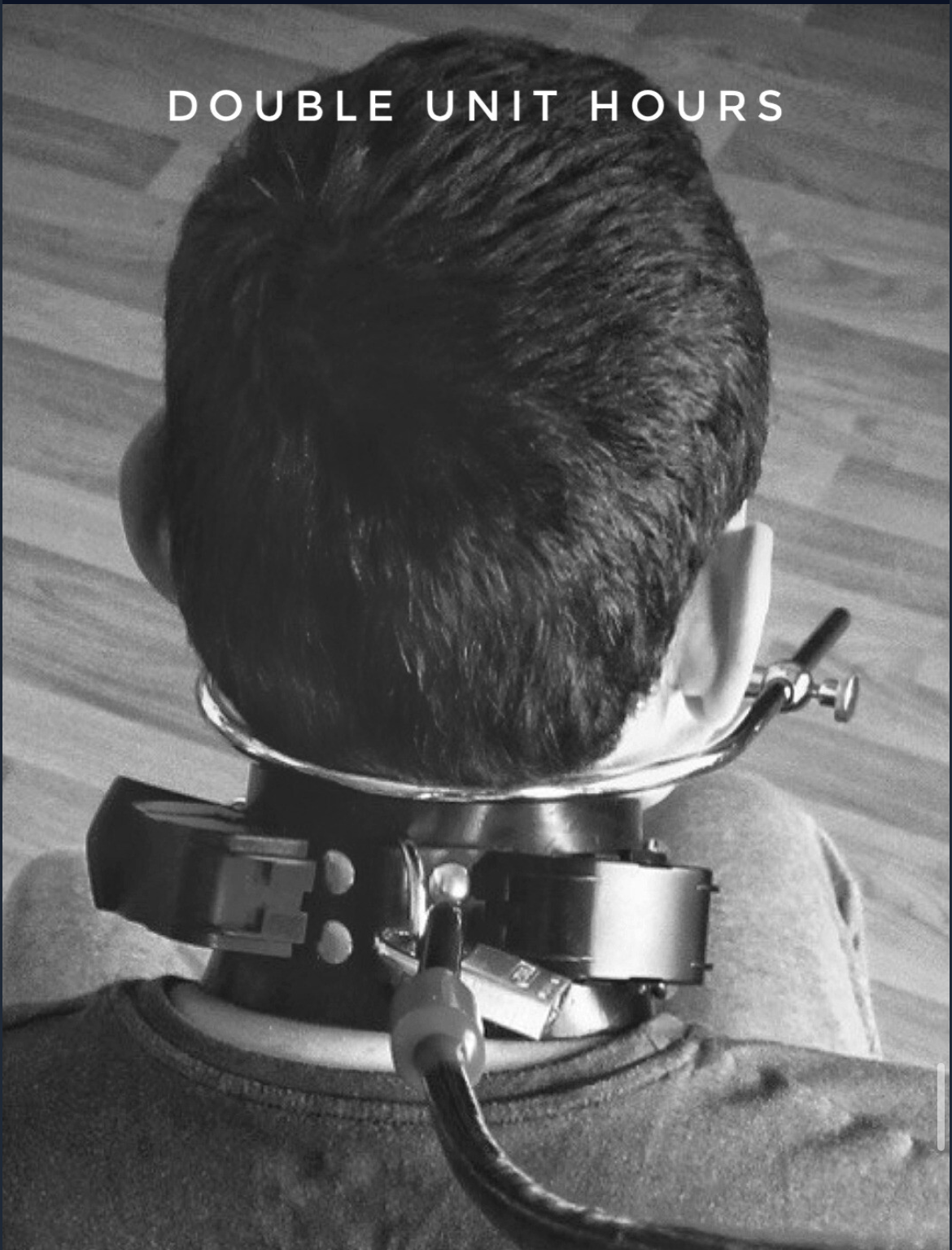
But this interactivity is only one example of a broad new range of sexual human behaviors that center the digital device/network in the coconstruction of the human body. The PiShock itself features in the main interface party settings that allow for a theoretically infinite number of user inputs to any single PiShock and the shocking units attached to it. Further, as PnP emphasizes, the accessible API allows any data stream (from human input to random number generators to any internet bits) to trigger varying lengths and intensities of shock. Outside the PiShock, as hinted at by this week’s post image, the operational capacities of computation are being used to explore a variety of new forms of embodiment and sexuality. If you can’t tell, that is a computer-controlled metal lock attached to an extremely robust collar and chain. Safety issues notwithstanding, this person has handed off his physical agency to either another user or a computational system (GenAI is being increasingly used for this purpose). What unifies party mode, API-triggered shock, and the GenAI-controlled lock is not control originating outside the disciplined body—that’s true of any D/s interaction. Rather, all three demonstrate the breakdown of dyadic-human interaction into digital sexual space, arrayed along a spectrum of abstraction from human agency: party mode still takes direct human inputs, but disperses and mediates them digitally; API triggers are less abstracted from human agency than pure automation, but still distinctly—philosophically—not the immediate product of human action; GenAI control is the most distantly abstracted from human agency of the three.
These automated practices (collar or PiShock) are outgrowths (advancements?) of a variety of (what now, only in retrospect, appear as) intermediate processes of using automated timers on boxes or attached to locks in order to produce digitally mediated loss of human agency. And that is the central goal of these practices: less about the specific sensations of pain or immobility, and more about the loss of agency (though, ideally, without significant compromise of safety). This loss of agency is itself a form of pleasure through the diminution/decentering of the subject—a properly Bersanian dissolution, an urge for freedom through the paradox of non-control. It offers a way to opt out of verticality and crushing normativity, albeit briefly, by decentering humanity in relation to and through technical objects.
PnP is the object meant to instantiate and demonstrate this theory. Specifically, I am engineering how much agency-loss occurs—enough to demonstrate the point, while preserving accessibility and sidestepping the consent issues that a piece like He Wants This is built to hold instead. Where HWT stages that more totalizing loss of agency, PnP allows the user-viewer to insert or dock themselves within an automated system of pleasure-pain, to experience the production of the body through automated experience on more accessible terms. In critical practice, my making this week focused on engineering a specific piece for my sculptural interface that doesn’t appear to exist without my initiating its intentional manufacture. As PnP obscures the “minishockers” and the PiShock itself, the “body port” (i.e., the part of the sculpture through which the human connects to the system) needs to be both ergonomic and accessible. Given the structure I’ve devised, I find that I need a means of securely and stably suspending a metal handhold inside a vertical tube—a greater challenge than initially expected. So, while I have been able to acquire a substantial portion of the needed supplies for the final build, this suspensory piece has so far evaded me. I have been able to, through a huge array of digital platforms, custom design one, but finalizing the measurements remains a stumbling block. This design-construction step and the testing that follows are what will occupy the next week.