These have been lingering in my dissertation folder for a while now. I may have shared them early on in the process, but I felt they were worth returning to now.
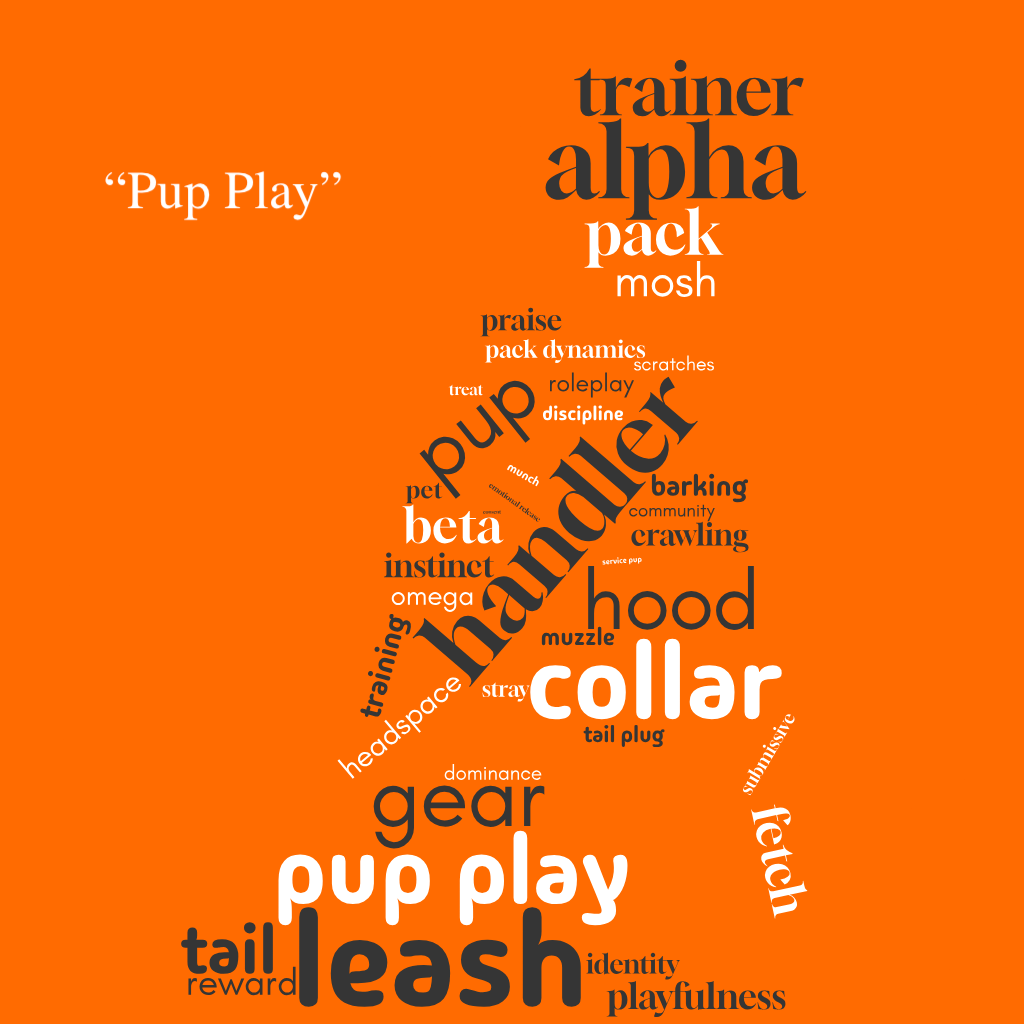


What do these clouds say?
Word clouds are a fascinating form of data visualization. It allows a text corpus to be rendered as a collection of tokens weighted by frequency of presence in the data set. When a certain word (here the various objects of study) are checked through as association engine (AI platforms are GREAT for this, but non-AI versions exist as well—thought that’s a sticky distinction!) the relative frequency of words can be illustrated. I have, as is my wont, taken the extra step of artifying my WCs, though in more practical research terms random colors and rotations should probably be omitted.
The utility of these words clouds for this project is manifold.
First, it provides a rich vocabulary that surrounds and informs discourse about/around the objects of study on the internet.
Second, the weighting of these terms in relation to frequency (likely) correlates to a centrality of a given term within these discourses (there are always outliers with BIG DATA). What stands out upon revisiting these visualizations is the apparent centrality of interpersonal power dynamics to these fetishes (something my committee has pointed out, but I have continued to neglect).
Extending this realization in conjunction with the feedback to “make it sexy”. I am realizing that the central thrust of this project has emphasized the global flows of power, the agency of objects and materials in systems intersecting with the body, the flow of power and energy between a subject and a digital audience (and to some degree a single digital partner). It has not accounted for the analog of physical aspects of these kink relationships—spaces where these attachments still function as mediating, agential, rhetorical bodily interfaces, but in which the digital might fade into the background. How might examining these more focused forms of interpersonal power exchange inform or reshape the sought understanding of these devices’ digital lives?
The ways in which the devices enact a form of distributed agency at these different valences stands out. Through these devices the body-subject is refigured, control and response become locatable in a tool, in another subject, in digital systems and technology, in a viewing other.